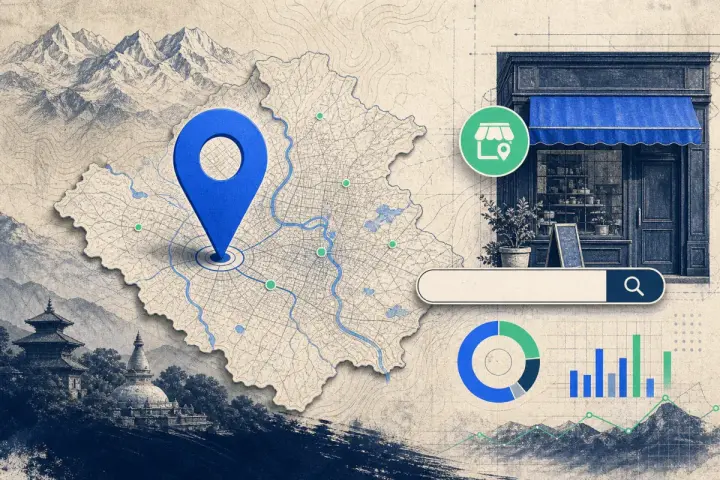
What local SEO actually is
Local SEO is the work of appearing when somebody searches for a service near them. A person standing in Baneshwor typing “dentist”, a traveller in Thamel searching “trekking agency”, a parent looking for “consultancy for Australia study visa”: all of these trigger a different part of Google than a general informational search does.
The visible difference is the map pack: the block of three business listings with a map, star ratings and directions that appears above ordinary results. The invisible difference is that it runs on its own ranking logic. Google weighs how close you are to the person searching, how complete and active your Google Business Profile is, how many recent reviews you have, and whether your name, address and phone number are consistent everywhere they appear online.
The practical consequence catches most business owners by surprise: you can rank in the map pack without ranking in ordinary search at all. A business with a weak website and an excellent profile routinely beats a business with a strong website and a neglected one.
Why this matters more in Nepal than most markets
Two conditions make local search unusually productive here.
Search happens on phones, in the moment. Nepal's internet use is overwhelmingly mobile, and mobile search skews heavily toward immediate, nearby intent. Somebody searching for a service on a phone is frequently going to act on it the same day. That is a fundamentally different visitor from someone reading a guide on a laptop.
The competition has not shown up. This is the part worth taking seriously. Walk through any Nepali business category on Google Maps and you will find unverified profiles, businesses with no photographs, opening hours that were wrong before the last Dashain, phone numbers that no longer connect, and profiles with a single review from four years ago. In many categories, simply being complete and current is enough to move ahead of most competitors.
That advantage will not last indefinitely. It is real right now.
The four commercial benefits
1. The intent is better than any other search traffic
A visitor arriving from “what is SEO” is researching. A visitor arriving from “SEO consultant in Kathmandu” is shopping. Local queries sit almost entirely in the second category, which is why a small number of local visitors frequently produces more revenue than a large number of informational ones.
2. You can outrank businesses with better websites
Because the map pack has its own ranking system, a strong profile is a route past competitors whose websites are older, larger and better linked than yours. For a new business, this is the fastest available path to visibility.
3. It produces contact without a website visit
Calls, direction requests and messages all originate directly from the profile. For restaurants, clinics, salons, workshops and consultancies, a substantial share of enquiries never touch the website at all.
4. Reviews do work you cannot do yourself
Reviews influence both ranking and the decision a customer makes after seeing you. They are the one asset in this discipline that a competitor cannot copy, buy convincingly, or replicate quickly.
What to actually do, in order
The sequence matters. Each step is cheaper and more effective once the previous one is done.
Step 1: Claim and verify the profile
Unverified profiles rank poorly and can be edited by anyone. Verification in Nepal is usually by postcard or phone and can take a week or two. Nothing else on this list works properly until it is done. If a previous agency or a former employee holds the profile, start the reclaim process now. It takes longer than people expect.
Step 2: Complete every field, then complete it again
Primary category is the single most consequential setting, because it determines which searches you are eligible for at all. Choose the most specific accurate option rather than the broadest. Then fill in secondary categories, services, opening hours including festival closures, service areas, attributes, and a description written for a person rather than for keyword density. Empty fields are ranking signals you are declining to send.
Step 3: Fix your name, address and phone everywhere
Google cross-references your details across the web, and inconsistency creates doubt. The usual Nepali complications are worth naming: mobile numbers written with and without +977, addresses given as a landmark rather than a street, and businesses listed under both an English and a Nepali transliteration. Pick one canonical version, then correct it across your website, Facebook page, and any Nepali business directories you appear in.
Step 4: Add photographs, and keep adding them
Photographs are the most visible difference between an active profile and an abandoned one, and they influence the choice a customer makes between three similar listings. Exterior shots that help someone recognise the building, interior shots, staff, and the actual work. Add new ones regularly rather than uploading twenty once.
Step 5: Ask for reviews, properly and continuously
Ask satisfied customers at the moment they are satisfied, not weeks later. Send the direct review link rather than instructions. Never buy reviews. They are increasingly detectable, and a cluster of implausible five-star entries damages credibility with the customers you were trying to persuade. Reply to every review, including the negative ones; a measured reply to a complaint reassures far more readers than the complaint deters.
Step 6: Give the profile a destination
Point the profile at a page that matches what the searcher asked for. A profile for a dental clinic should link to a page about the clinic and its services, not a generic homepage. If you serve several areas or several distinct services, build a page for each rather than one page attempting all of them. The site has city pages for Dharan and Itahari that show the pattern.
Which Nepali businesses benefit most
| Business type | Why local search matters |
|---|---|
| Clinics, dentists, diagnostic centres | Patients search by area and choose on reviews and proximity |
| Restaurants and cafés | Decisions made on a phone, minutes before arriving |
| Education consultancies | Parents and students shortlist nearby offices before visiting |
| Trekking agencies and hotels | Walk-in and same-day booking traffic in Thamel, Pokhara and trailhead towns |
| Salons, gyms, repair services, workshops | Almost entirely proximity-driven; reviews decide between near options |
| Real estate and legal services | High-value enquiries where credibility signals carry weight |
Businesses selling nationally online, or to customers outside Nepal, get less from this. Their gains come from ordinary organic search, where the general SEO fundamentals apply instead.
How to tell whether it is working
Ranking position is a poor measure in local search, because results change with the searcher's physical location. Somebody two kilometres away sees a different map pack than somebody outside your door. Chasing a single position number will mislead you.
Measure the things that reflect commercial outcome instead. Calls originating from the profile. Direction requests. Messages. Website clicks from the profile. Searches where you appeared, split between people looking for you by name and people looking for the service. Google reports all of these in the profile itself, and month-on-month movement in them is far more honest than a ranking screenshot taken from one location.
Add one number that only you can collect: when an enquiry arrives, ask how they found you. It takes a moment and it corrects a surprising amount of what the analytics imply.
Doing this yourself versus paying for it
Most of what is described above is genuinely within reach of a business owner with a free weekend. Claiming the profile, completing the fields, correcting listings, taking photographs, and starting to ask for reviews require diligence rather than expertise, and the returns for a business currently at zero are large.
Paying makes sense in three situations. When your category in your area is genuinely competitive and everyone has already done the basics. When you manage several locations and consistency becomes an ongoing operational problem. And when the local work needs to sit inside a wider search strategy (service pages, content, and technical health) rather than standing alone.
If you want the standing version of this work, that is what local SEO services covers. If you would rather do it yourself first, the Kathmandu local SEO checklist is the step-by-step version, and the Google Business Profile guide covers the profile itself in detail.
Frequently Asked Questions
The short version
Local search runs on its own ranking system, which means a complete Google Business Profile can put you above competitors with far stronger websites. In Nepal that opportunity is unusually wide, because a large share of businesses have profiles that are unverified, incomplete, or years out of date. Claim and verify, complete every field, make your contact details consistent everywhere, add photographs regularly, and ask every satisfied customer for a review. Measure calls and direction requests rather than positions.
Most of it is free. Almost none of it is difficult. The reason it works is simply that most of your competitors have not bothered.